


Largest Edition Of Global Food Week Concludes In Abu Dhabi
The largest edition of Global Food Week has concluded in Abu Dhabi, held under the patronage of His Highness Sheikh Mansour Bin Zayed Al Nahyan, Vice President of the UAE, Deputy Prime Minister, Chairman of the Presidential Court, and Chairman of the Board of Directors of the Abu Dhabi Agriculture and Food Safety Authority (ADAFSA). The week saw record levels of dealmaking, with 97 agreements signed worth AED 6.9 billion over three days, representing a 5% increase on the previous edition and reinforcing Global Food Week’s position as a leading platform for business, investment and collaboration across the global food and agriculture sectors.
Organised by ADNEC Group, a Modon company, in partnership with ADAFSA, Global Food Week 2026 saw the return of the second edition of the Global Food Security Summit and the 12th edition of the Abu Dhabi Date Palm Exhibition, organised in partnership with the Khalifa International Award for Date Palm and Agricultural Innovation. The Week also held the AgriTech Forum, alongside the launch of new events including the inaugural Abu Dhabi Honey Symposium and international workshops for the Food and Agriculture Organization (FAO) Policy Majlis and YalaFast programme.
Over three days, Global Food Week attracted more than 47,092 attendees, a 17% increase compared to the 2025 edition. For the first time, the event combined its business, trade and investment programme with a direct consumer experience, giving visitors the opportunity to view and purchase the latest food and beverage products from local and international exhibitors through the expanded Shop at the Show experience.
His Excellency Dr Tareq Ahmed Al Ameri, Acting Director-General of the Abu Dhabi Agriculture and Food Safety Authority (ADAFSA), said: “At ADAFSA, our mission is to build a sustainable and resilient food system that safeguards the wellbeing of our community today and for generations to come. Guided by the vision of His Highness Sheikh Mansour bin Zayed Al Nahyan, we recognise that food security cannot be achieved in isolation. The challenges facing global food systems, from climate change and water scarcity to supply chain disruptions, extend beyond national borders and require solutions based on international cooperation.”
He added that: “Global Food Week 2026 embodied this approach by bringing together leaders from the public and private sectors from around the world to address shared challenges and turn dialogue into practical action. By strengthening collaboration between governments, international organisations, investors and producers, we are helping to build stronger, more adaptive food systems that are prepared for future change. We will continue to support innovation, open trade and knowledge exchange to enhance supply chain resilience and secure a sustainable food future for the UAE and the world.”
Humaid Al Dhaheri, Group CEO of ADNEC Group, said: “The largest edition of Global Food Week has concluded, having achieved record-breaking results across exhibition space, exhibitor numbers, participating countries, visitor attendance and deal value. This success would not have been possible without the support and guidance of the UAE’s wise leadership, whose vision continues to strengthen the country’s position as a hub for innovation across these vital sectors. It also reflects the ongoing efforts of ADNEC Group to support the food security ecosystem, advance national industries, enhance the competitiveness of locally produced goods, and promote knowledge transfer. These achievements further reinforce Abu Dhabi’s position as the region’s leading destination for specialised events. Visitor numbers increased by 17% compared with the previous edition, reaching 47,000 attendees, while the total value of deals rose by 5% to AED 6.9 billion.”
He added that “Beyond the commercial results, Global Food Week has become a platform for exchanging knowledge. Through the Global Food Security Summit, the AgriTech Forum and the inaugural Abu Dhabi Honey Symposium, policymakers, researchers, farmers and industry leaders came together to share expertise and explore practical solutions to the food security challenges facing the world. I would also thank our partners at ADAFSA, and every exhibitor, speaker and visitor who helped make this edition a success.”
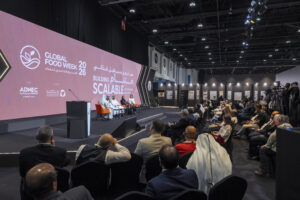
The second edition of the Global Food Security Summit took place under the theme “Global Collaboration for Food Security for All” and was opened in the presence of His Highness Sheikh Hamdan bin Mohamed bin Zayed Al Nahyan, Deputy Chairman of the Presidential Court for Special Affairs. Bringing together ministers, senior government officials, multilateral institutions and private sector leaders, alongside speakers from 30 countries, the Summit focused on moving food systems from resilience towards readiness for future disruptions. Sessions addressed the deployment of artificial intelligence and digital logistics, and the mobilisation of private capital into agricultural infrastructure.
Through its 12th edition, the Abu Dhabi Date Palm Exhibition further reinforced its position as a leading regional and international platform for the dates sector, reflecting the UAE’s sustained commitment over the past two decades to advancing date palm cultivation and production. This year’s exhibition brought together 100 exhibitors and participants from 12 countries, highlighting its growing international profile and expanding role in showcasing the latest innovations and technologies while fostering collaboration and unlocking new opportunities across the industry.
Global Food Week featured 2,580 exhibitors from 92 countries throughout the exhibition. Spanning eight specialised sectors across the food value chain, this year’s edition saw national exhibitors account for 67% of participation and international exhibitors 33%, while small and medium-sized enterprises represented 22% of exhibiting companies, with a dedicated SMEs & Local F&B Sector introduced for this event, underscoring the Global Food Week’s role in connecting emerging businesses with buyers and investors.
The Hosted Buyers Programme once again contributed to the edition’s success, organising structured meetings between exhibitors and pre-qualified international buyers, including commercial farm operators, food processors and global procurement teams.
The inaugural Abu Dhabi Honey Symposium, organised by ADAFSA in collaboration with Apimondia, the International Federation of Beekeepers’ Associations, made its debut at Global Food Week as the largest specialised scientific gathering for the beekeeping and honey production sector in the MENA region. Held under the theme “Sustainable Beekeeping in Arid Environments: Innovative Solutions and Technologies for Climate Change Adaptation”, the three-day symposium brought together international experts, researchers, policymakers, beekeepers and industry leaders.
Following the sessions led by experts from around the world, the symposium outlined key recommendations to strengthen sustainable beekeeping in the UAE, including recommendations, future opportunities and areas for research, and practical steps to support the sector in the years ahead.
The AgriTech Forum returned to Global Food Week, running across all three days and showcasing next-generation farming technologies, including controlled-environment agriculture, automated and precision irrigation systems, soil-regeneration research and AI-driven production models designed to reduce water consumption in arid environments. The final day featured sessions on international regulatory alignment, biosecurity protocols and cold-chain infrastructure across the Middle East.
The final day of the AgriTech Forum at Global Food Week 2026, themed around youth, research and innovation, opened with a keynote on Cultivating Human Capital: Bridging R&D and Youth Entrepreneurship for Resilient Food Production. Thomas Zandanel, FAO YALAFAST Representative, said young people are catalysts for change, with the ideas and technical skills to transform agrifood systems, and need the space, resources and funding to put them into practice. He highlighted the YALAFAST programme, which brought together 70 participants from 55 countries during the week, and said the network and partnerships formed will continue beyond the event, with FAO support for viable ideas.
A fireside chat on Breaking Barriers: Financial Incentives and Technical Support Instruments for Independent Rural Farmers was moderated by Fernando Marquez, Senior Economic Clusters Advisor. Dr Rida Al-Shibli, Executive Secretary of the Association of Agricultural Research Institutions in the Near East and North Africa, said the challenges facing small farmers are interconnected, spanning finance, technology, advisory services, markets and climate risk. He called for financial instruments matched to farmers’ seasonal cash flows, backed by technical and advisory support, and for a shift from short-term assistance to long-term investment. He stressed that research should start from farmers’ real problems, and that finance, technology, knowledge and markets need to be connected so that farmers are not left to navigate barriers alone.
During the forum, ADAFSA launched the After Winning Program, a new initiative of the Sheikh Mansour bin Zayed Al Nahyan Agricultural Excellence Award (SMAEA), at Global Food Week 2026. The programme aims to turn agricultural excellence into a sustainable journey of empowerment, innovation and knowledge transfer. H.E. Dr Tarek Ahmed Al Ameri said the programme responds directly to feedback from award winners, who asked for continued support after winning. . It will provide specialised programmes in capacity building and training, innovation and intellectual property, market access and partnership development, helping to enhance farmers’ competitiveness and support the continued development of the agricultural sector.
The Sheikh Mansour Bin Zayed Agricultural Excellence Pavilion hosted more than 150 award-winning Emirati farmers, livestock breeders and beekeepers, who showcased their products to investors, buyers and the public. The Farmers Majlis provided a platform for dialogue between Emirati growers and government specialists, while the Farmers Market allowed visitors to buy fresh produce and locally made products directly from UAE farmers and producers.
The Republic of India participated as this year’s Guest of Honour, reflecting the depth of the UAE–India strategic partnership in food, agriculture and investment. The Indian Pavilion included exhibitors and major trade associations representing key sectors of the food and agriculture value chain. During the week, a UAE-India Partnership and Investment Workshop took place. It aimed to establish practical partnerships that connect India’s manufacturing and production capabilities with the UAE’s advanced logistics, distribution, finance and regional trade infrastructure. The workshop concluded with a proposal to establish a joint working group comprising relevant stakeholders from both countries.
On the third day of Global Food Week, FAO hosted a session as part of the FAO Policy Majlis, highlighting its Hand-in-Hand Initiative. The programme aims to accelerate the transition towards more sustainable and efficient agri-food systems by directing efforts and investment to the regions and sectors most in need. The initiative seeks to deliver tangible development outcomes by contributing to the eradication of poverty (SDG 1), ending hunger and malnutrition (SDG 2), and reducing inequalities (SDG 10), thereby strengthening food security, supporting sustainable development and improving livelihoods.
Anthony Bennett, Global Co-ordinator for the Hand-in-Hand Initiative at FAO, explained that the global programme was launched in 2018 and is designed in partnership with countries to increase investment in agriculture and food production, particularly in areas with untapped potential. He noted that in 2022 the initiative was working with 20 countries across the Middle East, North Africa, Central Africa and Asia, and that by 2026 it had expanded to approximately 78 countries worldwide.
Global Food Week 2026 embodied a collective commitment to ensuring food security for future generations, leveraging Abu Dhabi’s strategic position as a hub for agricultural innovation and trade. It was a powerful platform showcasing the UAE’s leadership in food resilience and its role as a global hub for sourcing, investment, and innovation in the food sector.
600 Participants Form Over 50 Countries Continue Discussing Several Topics In ICASM-2023 In Abu Dhabi

Knowledge Summit Reviews AI Advancement And Its Use In Enhancing Quality Of Life